

The Lagging Indicator
Shaun Abrahamson and the Discipline of Ignoring Consensus


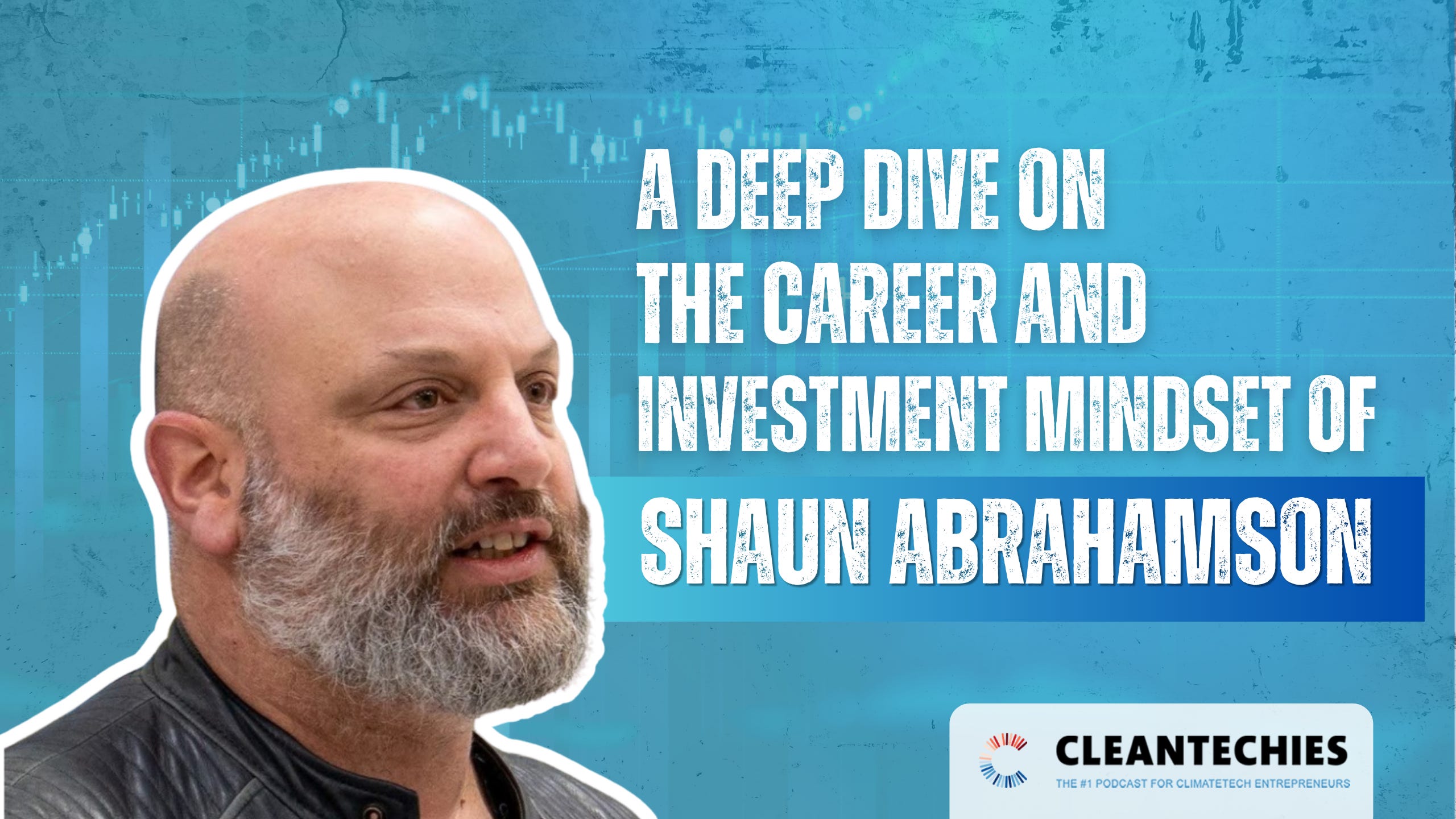
This is a guest post from Andrew Fink. He found our conversations with Shaun Abrahamson interesting and ended up doing a deep dive profile on him.
If you’re unaware, we’ve had Shaun on the podcast four times now.
Here, here, here, and here. Highly recommend the episodes bc Shaun has a lot of wisdom.
We’re Launching a CleanTechies Chatbot!
Well, technically, we are considering launching a new feature for our paid subscribers. But before we built it out (it will cost us a lot), we want to assess interest.
If you’d be interested in gaining access to a Chatbot trained on all of our content, please click the link below to indicate interest (note, this would be a benefit of being a paid subscriber to our Substack, which is $100 a year).
In the fall of 2013, Shaun Abrahamson walked down to the cul-de-sac at the end of his block on Miami Beach. The cul-de-sac dead-ended at Surprise Lake, an inlet between Biscayne Bay and the ocean where the neighborhood kids fished. From that one spot he could see fifty or so homes, each behind its own sea wall. On that particular day there was a king tide, the highest predicted high tide of the year, which was forcing the water to the top of the walls. In the older sections, where the walls were lower, it was already coming over.
Abrahamson had spent the previous decade operating on the assumption that climate was essentially a closed problem. He had studied it at MIT in the late 90s, working for a professor on physical simulations, when his introduction to the field came through a then-new concept called lifecycle analysis — a framework for accounting for the emissions embedded in every component of a physical product.
By 1999, two things seemed clear to him. The data was becoming available. The goal function was a choice. A designer who wanted to minimize emissions could do it; the only cost was that the answer often came in higher than the cheapest alternative. Regulators or consumers or some stakeholder would eventually demand the lower-emissions option. Accounting standards would follow. The whole thing would get absorbed into financial reporting the way Generally Accepted Accounting Principles had been a century earlier. It was a problem that would solve itself.
So he did the internet instead.
For a decade he took on a series of product roles and startup work across media, marketplaces, and digital infrastructure. He started angel investing with a handful of exits with ZocDoc, Refinery29, and CrowdTwist. But in 2013, right around the time of the king tide, he came across Graham Hill, who started one of the first successful climate blogs, Tree Huggers. It was then that he realized that we weren’t really dealing with an accounting problem anymore. It had been over a decade and there still hadn’t been traction made in climate.
But when Abrahamson started having conversations with some of the smartest investors he knew about whether there might be a thesis in what was then still called clean tech. The reaction was close to unanimous. Clean Tech 1.0 — the 2006 to 2011 wave of venture investment in solar, biofuels, and next-generation batteries — had failed spectacularly. One of the most prominent firms behind the first wave, Kleiner Perkins, had already seen hundreds of millions of dollars in cleantech investments written down. The broader cohort had lost billions. Everyone Abrahamson talked to either knew someone who had lost money in the category or had lost money in it themselves.
The advice was consistent: find something else.

ErthSearch: Fast + Accurate + Affordable CleanTech Recruiting
Delivering specialized CleanTech talent with unparalleled efficiency and results.
For the past ~6 years, I have been placing sales, engineering, and executive talent at CleanTech companies in the US (over 80 placements total).
Because of this podcast, I have a network that no other CleanTech headhunter can claim, meaning I’ll get you access to talent no one else can.
Past Work:
We helped ChargeScape (JV between Ford, Honda, BMW, and Nissan) make 8 key hires in 6 months, while saving them ~$380k in recruiter fees.
Hired Head of Sales, PM, and Marketing Manager at OptiGrid (resurrection of FreeWire Technologies) (PS: they are hiring again, reach out to Silas to learn more).
Guaranteed placement or you don’t pay!
It’s time to take your hiring seriously — get professional help today.
That didn’t stop Abrahamson. He said, “If I hear that things can’t be done or shouldn’t be done, it makes me more interested.”
It turned out that no one was making an argument from the underlying economics. No one said the math didn’t work, or the customer demand wasn’t there, or the unit costs couldn’t come down. The argument was sociological. People had tried. People had lost money. Therefore, the category was off-limits.
“Wait a second,” he remembers thinking. “This doesn’t make sense. People agree there’s a problem, and the idea that they can’t generate a financial return just seems like a bad assumption or bad analysis.”
The investors Abrahamson spoke with were not stupid. They were reading the signal their cohort’s experience had produced and drawing the conclusion the ecosystem had reached. Abrahamson’s response — to treat the consensus as a hypothesis rather than a conclusion, and to ask what the underlying math actually said — is the move he has spent the subsequent thirteen years making, over and over, in slightly different forms.
That fall, he and a small group of people decided to test the premise. They wanted to see whether, with a different frame and a different set of assumptions, it might actually be possible to build a climate fund.
The king tide receded. The accounting problem, it turned out, had not solved itself. And Abrahamson — a thirty-something with an engineering degree, a decade of consumer internet experience, and no formal track record as an investor — began the work of reopening a question the ecosystem had closed by starting his first venture fund, Urban Us in 2014.
–
Abrahamson had arrived at this point through a sequence of experiences that shared only one organizing principle: they were each from a different discipline than the last.
He grew up in Cape Town, then spent formative years in Zimbabwe during a period when southern Africa was renegotiating most of what it meant to live there. He studied electro-mechanical engineering at the University of Cape Town from 1992 to 1995, then traveled to the United States for a master’s in Computer Aided Design at MIT. His thesis was on integrated design in a service marketplace. The lab he worked in did physical simulations for industrial clients — automotive manufacturers, and at one point Bose loudspeakers. Abrahamson spent his graduate years learning to put the physical world inside a spreadsheet and ask it basic questions.
The habit of asking basic questions is the thing to notice. Abrahamson has said that he is somewhat dyslexic, that he cannot do much arithmetic in his head, and that he has spent his career compensating by putting every problem into a spreadsheet and reasoning through it from first principles. It is an engineering instinct but it is also, more precisely, a modeling instinct — the belief that complicated systems become legible when you can reconstruct them numerically and poke at the assumptions one at a time. This is unglamorous work and does not produce viral tweets.
But it does, over thirty years, produce a great deal of accumulated knowledge about why consensus positions are often wrong. He took this thesis with him as he entered climate investing, focused on hardware.
There is a question Abrahamson asks early in almost every conversation with a hardware founder, and it determines more of what follows than the founder usually realizes.
The question is whether the company requires building LEGOs or assembling them.
Building LEGOs
A founder who answers building LEGOs is saying that they intend to engineer a new component at the heart of their product — a new chemistry, a new process, a new piece of industrial equipment — before they can begin delivering it. A founder who answers assembling LEGOs is saying that the components already exist, that multinational suppliers have been making them for decades, and that the company’s job is to combine them in a new way.
Abrahamson came to see two paths. One that could take years to reach revenue, required building a supply chain from scratch, and consumed enormous amounts of capital before a first product ever shipped. And another that moved faster, worked with existing suppliers, and reached the market with far less capital.
Most venture investors do not ask this question. The hardware VC ecosystem inherited its instincts from software, where vertical integration of the stack became a virtue — the more of your infrastructure you built yourself, the more defensible you were. In hardware, the logic runs the other way. “We have thirty to forty years’ worth of hardware playbooks that work,” Abrahamson said on the CleanTechies podcast episode #136. “So why are we discussing new things?”
The playbooks he has in mind are not obscure. Apple’s first computer was assembled largely from components that Homebrew Computer Club attendees could source themselves, and its earliest financing came not from venture capital but from a purchase order that funded production. NVIDIA built a world-changing company as a design firm, outsourcing manufacturing to TSMC. Tesla’s first car was built on an existing chassis and supply chain, with its core innovation concentrated in the battery and powertrain. And SpaceX, in Elon Musk’s own telling, started with a spreadsheet—a techno-economic model that showed rockets should cost far less than they did—before building the capability to prove it.
Each of these companies made a decision about what to build and what to buy. Each of them got the decision right. And each of them has been celebrated, in retrospect, for the opposite of what actually happened — for the founder’s ambition rather than their restraint, for the company’s eventual vertical integration rather than their initial restraint about it. The venture ecosystem absorbed the celebration and missed the lesson.
Abrahamson did not miss it, because he had already read Ronald Coase.

Make your next high-stakes moment count
In clean tech, it’s not enough to build something important. You have to explain it clearly when it matters — to investors, on stage, and on TV.
Lehmann’s Terms prepares founders and executives for those moments so their message is clear, concise, and actually lands.
Lehmann’s Terms draws on experience preparing leaders for hundreds of national media appearances and a background in climate communications on Capitol Hill.
Don’t risk a bad answer costing you. Make sure your next opportunity creates real value.
Learn more: ltmediatraining.com
The Coase Question
On September 4, 2013 — before Urban Us existed, before the king tide, before climate investing was something Abrahamson was publicly willing to call himself doing — he published his first-ever Medium post titled “The 1937 paper every entrepreneur should read.” The occasion was Coase’s death three days earlier at the age of 102. The paper was The Nature of the Firm, Coase’s 1937 essay on the question of why firms exist at all — why work is sometimes organized inside companies and sometimes outside them, mediated by markets. Coase’s answer was that firms exist to reduce transaction costs: the hidden costs of finding, negotiating with, and enforcing contracts against outside providers. When transaction costs are high, firms expand. When they fall, firms contract.
“I believe some of the most disruptive organizations of our time,” Abrahamson wrote, “have been successful because they have chosen to rethink who is doing the work.”
The post listed examples — Uber, Airbnb, the freelance economy, the rise of reputation systems — that would have been familiar to any 2013 internet reader. But Abrahamson’s framing was subtly different from the standard techno-optimist version of the same observation. He was not arguing that the internet had made everything cheaper. He was arguing that the internet had made it possible to ask a Coase question that had previously been impractical to ask: who, actually, should be doing this work?
The answer, for a growing number of companies, was not us.
What Abrahamson would spend the next decade doing in practice, was apply the Coase question to hardware. The venture ecosystem’s SaaS-era instincts treated vertical integration as strength. The hardware playbook treated it as the opposite: integration was a decision to take on a transaction-cost burden that the market had already solved. A founder who insists on designing and manufacturing a custom component is taking on the supply-chain risk, capital intensity, and timeline exposure of companies that have been doing that work for decades. When the same founder could instead buy the component from a vendor whose reputation for delivering it is public, verifiable, and priced.
Which is why, when Abrahamson looks at a pitch for a hardware startup, the first thing he wants to see is a bill of materials where the most expensive line item is a part number from a known company. The logo matters. If the biggest component is something the founder intends to make themselves, the company is about to spend five years proving something a supplier proved in 1987. If the biggest component is a part from a company that sells a hundred million of them a year, the founder can focus on the thin layer of novel engineering that actually makes the product different — the controls, the software, the integration — and ship revenue in twenty-four months instead of sixty.
This framing has produced specific portfolio outcomes. Future Motion, the maker of the Onewheel self-balancing skateboard, was one of Abrahamson’s early investments and is one of its most durable. The Onewheel is not an engineering marvel in the sense that its components were invented for the product. It is an engineering marvel because the team made careful decisions about which existing components — the brushless motor, the lithium-ion battery chemistry, the balance-control algorithms — to combine in a new configuration. Future Motion reached profitability early, used crowdfunding to pre-sell units before building them, and has grown without requiring large follow-on equity rounds.
The Coase post is twelve years old now. Over the decade that followed, Abrahamson put it to work in the questions he asked, the companies he backed, and the ones he passed on. The LEGO thesis is Coase applied to hardware.
Securing Billions in Grant Funding for Climate Tech
Since 2020, Climate Finance Solutions (CFS) has helped climate tech companies secure over $1.6 billion in government grant funding, with a success rate of more than 90%.
Its team has also won over €500 million in European funding and managed $275 million in grant projects.
As a global consulting firm, CFS guides clients through the full funding lifecycle, from strategy and funder engagement to proposal development and post-award management. Its Grant Identification Platform enables real-time monitoring and custom matching of opportunities, with alerts as new grants are released.
CFS also supports investors, accelerators, and ecosystem builders through its partnership program, offering pro bono support for portfolio companies.
Learn more about CFS’s work and approach at ClimateFinanceSolutions.com.
Somewhere around 2015, Abrahamson had read a Fred Wilson post on the difference between venture capital and private equity. The line that stuck with him was a passing observation Wilson made about his own industry: “Many venture capitalists and venture capital firms ‘go along for the ride’ with the entrepreneur and don’t do much to change the trajectory of the investment.”
Most VCs would have read the line as a gentle critique and filed it. Abrahamson read it as a diagnosis he was implicating himself in. He published a Medium post later that year — titled, with characteristic Abrahamson bluntness about his own limitations, “Why seed investing is hard: exploration versus exploitation” — in which he admitted that his angel investing had suffered from exactly the problem Wilson named. “After a few years,” he wrote, “I decided that I needed to get serious and focus on ‘deploying capital.’ After a few more years, I wasn’t too happy with my progress — for my next batch of investments, I often didn’t feel like I could help as much because I no longer had the time to dig into the businesses.”
The rest of the post was an argument for what an early-stage firm might do about it. Abrahamson looked at KKR, specifically its multi-decade investment in operational consulting, and asked what the comparison would be at the seed stage. He looked at a16z’s content machine and asked whether media infrastructure might be treated as a portfolio service. He looked at Techstars’ corporate partnership model and asked whether corporate customers might be systematically matched with startups at the earliest stage. He looked at Rocket Internet and asked what a shared-infrastructure model would look like if the companies sharing the infrastructure were operating in the same space rather than cloning each other’s business models.
What he was describing, in effect, was not a venture fund. It was a platform with a venture fund attached.
Over the decade that followed, Abrahamson built five distinct components of that platform. Each one has its own history, its own economics, and its own relationship to the Wilson diagnostic. Together, they amount to an argument that the trajectory-changing work a venture investor is supposed to do is not possible to do as a venture investor alone.
The first component is non-dilutive capital.
When Abrahamson and his team went looking for educational material on non-equity startup financing in the mid-2010s, they found two articles. One was from Y Combinator. One was from the Kauffman Fellows. Both were about venture debt. “That was the sum total of startup land exposure to lending,” Abrahamson has said. The gap was not technical. The capital existed — banks, credit funds, revenue-based financiers, off-takers, asset-backed lenders, grant programs. What did not exist was a bridge between those capital sources and early-stage climate hardware founders who had never been taught the vocabulary, much less the underwriting logic.
Their response was to build the bridge. Abrahamson walks his founders through the capital stack one instrument at a time from customer prepayments, off-take agreements, venture debt, revenue-based financing, supply-chain credit, and leasing structures for companies whose customers would rather lease than buy capital equipment. Grants are a category unto themselves, and Abrahamson routes founders through Climate Finance Solutions, a specialist firm that has helped clean-tech startups win over $1.6 billion in grant funding since 2020.
The second component is URBAN-X.
In 2014, BMW’s MINI division had approached Abrahmson about running a new accelerator program for urbantech startups. The alignment was there — BMW was investing beyond the automobile, into real estate and mobility services, and wanted a partner who could source and coach early-stage companies in the space. Abrahamson declined as he had just started testing his own thesis. He did not, yet, have a firm with the capacity to run an accelerator for someone else. He took an advisory role instead.
Three years later, in 2017, Abrahamson accepted the offer he had initially turned down and it ran for five cohorts. The results were unusual for an accelerator. The program graduated 56 companies. When he took over, 35 percent of a typical accelerator cohort had raised follow-on funding. When URBAN-X ended, the number was 90 percent. The oldest cohort’s Series A rate was 71 percent. Portfolio companies raised over $335 million in aggregate and reached over a billion dollars in enterprise value within four years. The program produced exits to Octopus Energy and BP.
The reason URBAN-X outperformed is clear in retrospect — it was a thematic accelerator with a corporate partner that could function as an actual first customer, coached by investors who had been operating in the category for a decade, embedded in a community of climate-focused investors and operators the founders could actually draw on. The generalist accelerator model treats its corporate partners as sponsors. URBAN-X treated BMW as a go-to-market channel. The structural difference is why the graduation rate nearly tripled.
The third component is Perl Street.
In 2018, Abrahamson and his team noticed that a particular subset of their portfolio companies kept hitting the same wall. These were hardware companies whose business models required them to own the hardware — residential batteries, irrigation controllers, co-living spaces, micromobility fleets. The companies were generating revenue through subscription or leasing arrangements, but their balance sheets were being crushed by the cost of the assets. Venture equity was the wrong capital for the problem. Traditional asset finance firms, banks that specialize in auto loans or commercial real estate mortgages, were not set up to underwrite risk on assets they had never seen before. The capital gap was large and growing. Nobody was filling it.
Abrahamson launched Perl Street in 2018 to fill it.
The thesis, as Abrahamson and the founding team published it publicly: “Can we help early-stage urbantech startups by funding their assets? Can we identify useful insights from the data generated by these assets? Will these insights be valuable to founders and investors?”
The firm started with a proof-of-concept fund, provided project finance to startups the team knew well, and entered into data agreements with each portfolio company to build a dataset on how new asset classes performed in the field. Perl Street eventually became a distinct company, raised outside capital, and joined Y Combinator’s winter 2021 batch as a credit-as-a-service platform for climate hardware. Perl Street is now Abrahamson’s dedicated credit strategy — distinct from the venture fund, launched specifically because the venture model could not solve the problem Abrahamson kept watching his founders run into. It is the operational consummation of the Fred Wilson diagnostic.
The fourth component is the coaching and advice work.
This is the component that does not appear on a website and does not produce a press release. It is the one Abrahamson tends to describe when founders ask what his firm actually does. I heard Abrahamson on a podcast compare the investor’s role to parenting: “There’s an important part of parenting which is sometimes you’re just supposed to be the person that says, I believe.” In another, he described it as being one of a very short list of people a founder can call when things are going sideways. Not the founder’s spouse, not their parents, not their close friends, because those people are not equipped to assess the business.
A few examples of his coaching include:
Fundraising: he pushes founders into repetition by building investor lists, refining the story, and running the process daily until they develop competence through volume.
Co-founder selection: he encourages founders to create artificial deadlines and decisions early, forcing a new partnership to operate under pressure before the real stakes arrive.
Customer signal: he helps founders interrogate hesitation by pushing them to treat uncertainty as data and to question whether the problem is actually painful enough.
There’s an art of being direct with a founder when the ecosystem has trained VCs to be relentlessly encouraging. Abrahamson has said that his first attempts at direct feedback in angel investing went badly with one founder who stopped speaking to him for twelve months. He has also said that over time more than half of the founders he has been direct with have told him it made a difference. The coaching is not a bedside manner. It is a deliberately cultivated willingness to tell a founder the hard thing when nobody else will.
The fifth component is category positioning.
This is the least obvious of the five, but it is among the most consequential. Over the two decades Abrahamson has been investing, the vocabulary around climate has changed repeatedly. It has been cleantech, then climate tech, then sustainability, then ESG, then — most recently, under political pressure — some combination of reindustrialization, energy security, and national defense. Each shift has produced a new set of assumptions about what kinds of companies belong in what kinds of funds, which customers will pay, and which LPs will allocate. Much of Abrahamson’s behind-the-scenes work with its founders is helping them figure out how to position their company for a capital environment that keeps renaming itself.
The operating principle is consistent across the renamings. “The best climate companies are just great companies that happen to also be good for the planet,” Abrahamson has said. The climate benefits go on the company’s about page. The customer benefits go on the homepage.
A recycled nylon materials company should lead with a better, cheaper, stretchier fabric and treat the lifecycle-analysis story as the second paragraph. A full-stack electric trucking company should lead with the asset-finance economics and treat the emissions profile as a consequence. “The world is very predictable,” Abrahamson has said, in a different context; the world as a customer is especially predictable. Customers behave selfishly. They pick the thing that is better, faster, cheaper. The founder’s job is to make sure that thing is also, quietly, good for the planet.
What all five components share is a premise that Fred Wilson articulated in 2015 and that Abrahamson has spent ten years operationalizing: the work a venture investor is supposed to do is not actually possible to do as a venture investor alone. It requires infrastructure that most early-stage firms have decided is not their job to build.
Abrahamson has decided, over the better part of a decade, that it is.
In October 2008, at the moment the financial crisis was breaking across the American economy, Sequoia Capital held a meeting with the CEOs of its portfolio companies and presented a fifty-six-slide deck titled “RIP Good Times.” Doug Leone, then the firm’s managing partner, delivered most of the message. The deck is famous in Silicon Valley for a single instruction that appeared, in various forms, across nearly every slide: cut your burn, extend your runway, prepare to survive eighteen months without raising again, and do it in thirty days rather than six months. A gradual program of cost reduction, Leone explained, would bleed the company out. The companies that survived the downturn would be the ones that cut fast.
The deck became a cultural artifact. Founders referenced it in tweets. Investors referenced it in board meetings. By 2010, with interest rates at zero and money flowing back into venture at volumes that would eventually dwarf the 2008 peak, the deck was remembered as a document from a specific crisis — a useful artifact of 2008, retired until the next downturn.
Abrahamson read it differently. He read it as a permanent operating principle.
The reason he read it that way is structural, and it traces back to a framing he returns to in nearly every hardware conversation. A software company operates with 90 percent gross margins. A hardware company does well at 60. The thirty-point margin difference is not a matter of comfort; it is the operating condition of the company.
When a software company ships a bug, users are mildly annoyed; when a hardware company ships a bug, units come back, revenue disappears, and working capital that could have funded the next production run is now tied up in returns processing. A hardware company that misses revenue for two quarters does not have the luxury of raising a down round to buy time. The math does not work the way it works for software. The Sequoia 2008 discipline was not a crisis playbook. It was the baseline condition of building anything in the physical world.
Which is why, in September 2019 — a full ten years into what everyone except a few contrarians understood to be the longest bull market in American history — Abrahamson published a Medium post titled “Plan B.”
The post was, on one level, a typical macro essay. Abrahamson walked the reader through an inverted yield curve, University of Michigan consumer sentiment data, and a recession forecast from the economist Arturo Estrella. On another level, the post was a republication of the Sequoia 2008 memo for an audience of 2019 founders who had never experienced a downturn.
Abrahamson quoted “RIP Good Times” directly, reproduced several of its slides, and walked the reader through the components of a plan to survive flat or declining sales for at least twelve months without needing to raise outside capital. Cash flow positive as soon as possible. Focus only on product essentials. Collect receivables. Negotiate payables. Zero-based budgeting. Personal burn conversations with the team. Grants. Venture debt. Revenue-based financing. Asset-backed lending. “Plan A” was the Series A. “Plan B” was the alternative for a working company that did not require outside funding to continue operating.
Abrahamson’s argument, in the final paragraphs, was that startups of all stages should treat Plan B not as a fallback but as a preparation. “In building out a Plan B,” he wrote, “You win twice. You are ready when the slowdown arrives and you can see a different path to continue building with less cash.”
The recession he was writing about did not arrive on the schedule he expected. The COVID crash of early 2020 was followed by the most aggressive monetary response in modern history, and what happened in venture between 2020 and 2022 was the opposite of what a cautious 2019 reader of Plan B would have predicted. Funds got bigger. Rounds got bigger. Burn rates got bigger. Valuations detached from revenue for two consecutive years. By the time the Federal Reserve began raising rates in 2022, the venture ecosystem had normalized a funding environment that had no precedent in the previous thirty years.
The correction that followed was severe, specific, and structural. The number of active venture funds dropped by roughly half from the 2021 peak. Follow-on rounds became concentrated in AI-adjacent companies, which received the majority of deployed capital. Series A metrics, which for a decade had been a moving but legible target, stopped being legible at all. Founders outside of AI could no longer get a straight answer from their investors about what revenue or growth rate they needed to hit in order to raise again. The consensus had not just repriced. It had become unanswerable.
Abrahamson has described this as the moment Plan B became Plan A.
ErthSearch: Fast + Accurate + Affordable CleanTech Recruiting
Delivering specialized CleanTech talent with unparalleled efficiency and results.
For the past ~6 years, I have been placing sales, engineering, and executive talent at CleanTech companies in the US (over 80 placements total).
Because of this podcast, I have a network that no other CleanTech headhunter can claim, meaning I’ll get you access to talent no one else can.
Past Work:
We helped ChargeScape (JV between Ford, Honda, BMW, and Nissan) make 8 key hires in 6 months, while saving them ~$380k in recruiter fees.
Hired Head of Sales, PM, and Marketing Manager at OptiGrid (resurrection of FreeWire Technologies) (PS: they are hiring again, reach out to Silas to learn more).
Guaranteed placement or you don’t pay!
It’s time to take your hiring seriously — get professional help today.
The Speedstrapping Playbook
In October 2025, Third Sphere (Abrahmson’s rebranded VC firm) published a document called the Speedstrapping Playbook (part 2). The document is a long sixty-odd pages in draft form, with sections on capital stack design, AI-enabled productivity gains, case studies of portfolio companies that have operated on the model, and a comparative table of “traditional VC path” versus “speedstrapping path” decisions. The opening epigraph is a line from Bill Gurley, spoken in June 2025 on a podcast: “The system as it exists today promotes less liquidity, less traditional, high-quality company building, and way higher burn rates. That’s just not a great combination from my perspective.”
The playbook’s central claim is compressed into two sentences: “Speedstrapping used to be a plan B for those who couldn’t find the path to growth VC. But now we believe speedstrapping should be plan A for founders, even those that work in capital intensive businesses.” Everything else in the document is an unfolding of what that means in practice with customer prepayments, grants, non-dilutive capital stacks, early revenue as validation, AI-enabled efficiency, and a conscious inversion of the Series A metrics chase.
The components of speedstrapping are the components of the Lego thesis and the platform thesis compounded together and pointed at a new market condition. Build with off-the-shelf components, because it gets you to revenue in two years instead of five. Stack non-dilutive capital on top of minimal equity, because the platform Third Sphere has been building since 2015 is there to do it. Use AI to replace the headcount expansion that Series A capital used to fund, because the productivity gains are real and the math of a small team with AI tools running at 40–60 percent higher efficiency is actually competitive with a larger team burning capital to grow. The framework is new. The intellectual components are not. Every one of them has been present in Abrahamson’s public writing for at least six years, and most of them for more than a decade.
The portfolio examples in the playbook make the point economically. Revivn, the e-waste processing company that grew from an unheated warehouse in New York — the team famously held an early investor video call wearing winter coats to save on heating — into a global circular economy business at 2x revenue growth year over year, without needing to raise additional capital after its seed round. Cycle, the European e-bike leasing company that used off-balance-sheet asset finance structures to fund fleet growth without cap-table dilution and became the largest in its category. Wasted, the portable sanitation company that financed its first vehicle fleet through grants and pilot customer payments. These are not companies that failed to raise a Series A. They are companies that were designed, from the first check, not to need one.
“You’re not giving up from an optionality perspective,” Abrahamson has said about the model. “You can still go and raise a Series A if you want, and it works out. But you’ve flipped the optionality. If you were aggressively trying to hit growth metrics and burning cash to get there, you’ve put your company at risk, and in many ways, from our perspective, for no reason.”
The venture consensus on growth-at-all-costs was not wrong for software companies under the capital conditions that prevailed during its era. But it was never the only playbook. It was a playbook, calibrated to a specific type of company operating in a specific cost environment, that eventually became the playbook by default. The default put companies at risk. The risk was not necessary. Speedstrapping is what is left when you remove the unnecessary risk.
It is also an invitation to reconsider what “consensus” actually means. The Sequoia 2008 memo said exactly the same thing. The 2019 Plan B post said exactly the same thing. The Speedstrapping Playbook, in 2025, is saying exactly the same thing. The ideas have been public for years. The consensus catches up slowly, if it catches up at all.
Everything Abrahamson has built since the water started rising in Miami in 2013 is a response to an early lesson he did not fully recognize at the time. He has spent thirty years refusing to accept consensus positions without examining the math underneath them.
He read Coase in 2013 and concluded that the venture ecosystem’s instinct toward vertical integration was a SaaS-era habit that did not survive contact with hardware. He read Fred Wilson in 2015 and concluded that most of what venture firms called “value-add” was a self-congratulatory fiction. He read the Sequoia 2008 memo as a permanent operating discipline rather than a crisis artifact. He has made each of these observations publicly, a decade or more before the ecosystem caught up with him. And in each case, the ecosystem has caught up for the same reason that lifecycle analysis did not become a standard. Consensus is a lagging indicator. It moves when enough people have been burned by its absence. Sometimes it does not move at all.
The MIT memory is the first documented instance of Abrahamson reading a room and trusting it more than the numbers. Everything since suggests he learned not to.
There is a way of describing a career like Abrahamson’s that would make it sound heroic. The contrarian investor, the ten-year visionary, the one who saw the future while everyone else chased the present. Abrahamson himself would reject the description, and he is right to reject it. The pattern is not heroism. It is the slow, unglamorous work of going to primary sources in adjacent disciplines and asking whether the consensus in your own discipline has correctly read them. Most of the time, the consensus has not. Most of the time, the ideas are already present in someone else’s work, waiting for someone willing to cross the disciplinary boundary and apply them.
The work has also, over thirteen years, produced specific outcomes. Three Urban Us unicorns. Five exits. A top-decile fund performance across three vintages. The number-one-ranked early-stage climate fund in North America by 2021. An accelerator that tripled its graduation rate. A credit fund spun out to Y Combinator and built into a standalone business. A playbook that dozens of climate hardware founders now operate from, whether or not they have ever met Abrahamson. The outcomes, in aggregate, are what happen when a fund spends a decade operating from premises the rest of the ecosystem is not yet ready to operate from. They are also what happens when an investor actually reads the manuals.
The MIT graduate student thought the problem was closed. It was not. The amateur investor watching salt water come up a Miami street reopened it. The seasoned investor running a venture platform with three unicorns and a playbook for a generation of founders who were not yet born when lifecycle analysis was first proposed has learned that very few problems are as closed as the people currently inside them believe.
Consensus is a lagging indicator.
The people who build things that last go back to the manuals the consensus forgot to read.
~Andrew Fink
Enjoyed this piece? Subscribe to The Pursuit for more deep dives into how the world’s best think, make decisions, and pursue excellence.
And if you’re an investor or founder looking to turn your insights into long-form editorial content, let’s connect.
Links
This podcast is NOT investment advice. Do your homework and due diligence before investing in anything discussed on this podcast.-
 | A guest post by
|